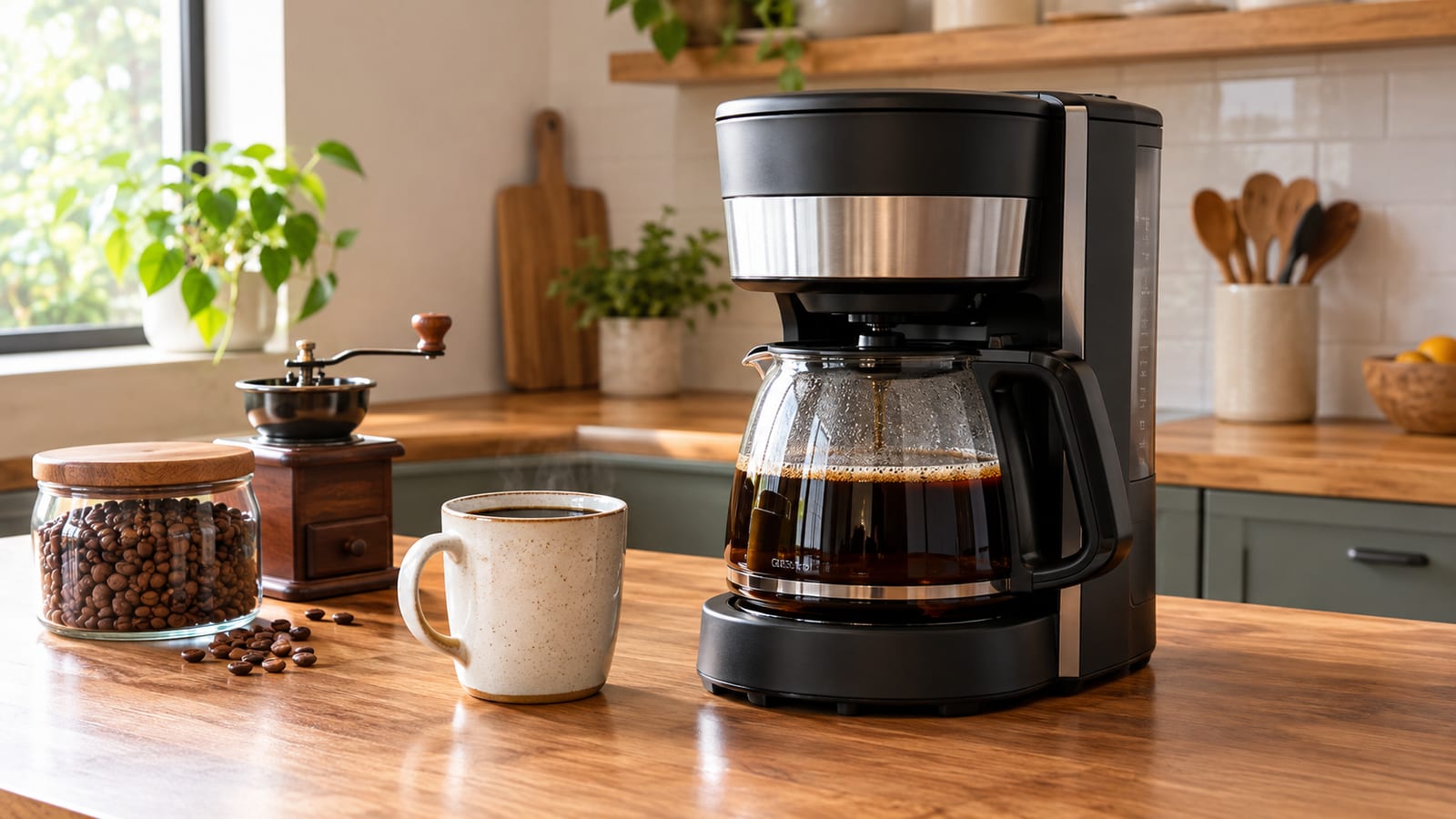
A drip coffee maker lives or dies on three dull jobs: heat water to 195 to 205°F, wet the grounds evenly, and give them enough time. Buy the OXO Brew 8-Cup Coffee Maker. It does all three well and makes a balanced, sweet pot without burying you in buttons. Fresh beans and a sensible ratio still do more for your cup than any feature list.
If money is tight, the Braun BrewSense is the budget pick. If you want a machine built to last for years, look at the Technivorm Moccamaster KBGV Select. The rest of this page covers how to choose one and how to get better coffee from the machine already on your counter.
What makes a drip coffee maker worth buying?
Four things matter, and none of them show up on a spec sheet as a flashy feature.
- Even water delivery. The showerhead is the part that drips water onto the grounds. It should wet the whole bed. A single stream hitting the center leaves the edges dry and the middle overcooked.
- Stable temperature. That just-below-boiling target comes from the Specialty Coffee Association (SCA), the global coffee trade non-profit. Cheap heaters often run cooler, and cool water brews thin, sour coffee.
- Sensible capacity. Buy for the amount you actually drink on a normal morning. A huge machine making a small pot usually brews it badly.
- The right carafe. Glass on a hot plate suits people who finish the pot fast. A thermal carafe suits slow sippers.
Clocks, strength buttons, and apps are optional. Get the four basics right first, and the extras can sweeten the deal.
The best drip coffee makers to buy
Every machine here gets the brewing basics right. The real choice is pot size, carafe type, and how much you'll pay for a machine that lasts.
| Pick | Best for | The trade-off |
|---|---|---|
| OXO Brew 8-Cup Coffee Maker | Most people | Smaller pot than a big family needs |
| Braun BrewSense Drip Coffee Maker | Tight budgets | Fewer controls, hot plate to manage |
| Technivorm Moccamaster KBGV Select | Buy-once kitchens | Steep price for what lands in the cup |
| OXO Brew 9-Cup Coffee Maker | Bigger households | Larger footprint, more settings to learn |
| Technivorm Moccamaster KBTS | Slow sippers | Premium price, carafe needs regular scrubbing |
OXO Brew 8-Cup: best overall
This is the one I'd put in most kitchens. It holds its brewing temperature well, and the showerhead wets the grounds evenly. As a result, the pot tastes sweet and balanced from the first cup to the last.
The simple dosing guidance helps too, because the wrong amount of coffee is where most bad pots start. The only real catch is size. If you're filling mugs for four every morning, step up to its bigger sibling.
Braun BrewSense: best budget pick
The BrewSense is plain, compact, and easy to live with. Feed it fresh grounds and a proper dose, and it makes a satisfying, honest pot.
You give up some control at this price, so lean harder on good beans and a scale. Also, don't leave the pot sitting on the warming plate for long. Pour it into a thermos once it's done brewing.
Technivorm Moccamaster KBGV Select: best premium pick
The Moccamaster is fast, tough, and gets the brewing fundamentals right every time. It's the machine people keep for years and hand down.
Be clear about what you're paying for. Most of the price goes into build quality. Stale beans will still taste stale, so only buy it if durability matters to you as much as flavor.
OXO Brew 9-Cup: best for larger households
The 9-Cup gives you a bigger pot and scheduling, so you can set it the night before. It keeps the same controlled, even extraction that makes the 8-Cup good.
That makes it the pick for families or offices that drink coffee steadily all morning. However, it takes up more counter space, and there are more settings to learn.
Technivorm Moccamaster KBTS: best thermal carafe pick
The KBTS brews with the same strong performance as other Moccamasters, but into an insulated carafe. That means no hot plate slowly cooking your coffee.
It's the right call if one pot lasts you two hours. Just know that a thermal carafe hides how much is left, and its insides need a good scrub every week or so.
How to judge a brewer side by side
The fair way to compare drip machines is simple. Brew the same beans, at the same grind and dose, in each machine on the same morning. Then compare these points:
- Flavor: Is it sweet and clear, or sour, bitter, or flat?
- Brew temperature: Does the water reach the SCA range and stay there?
- Extraction balance: Does it taste even, or sour and bitter at once?
- Brew time: Time the full cycle on your phone. Wildly fast and painfully slow both show up in the cup.
- Repeatability: Does the same recipe taste the same every day?
- Usability: Can you fill, load, and pour it half awake?
- Cleanup: Do the basket and carafe come apart and rinse easily?
- Carafe performance: Is the last cup still hot and still tasting like coffee?
You can run a rough version of this test at home. Brew the same bag three mornings in a row with a weighed dose. If the pots taste different each day, the machine is inconsistent, and no recipe will fix that.
Why brew quality beats feature count
Every taste problem in a drip pot traces back to how water meets coffee. Here's how each part of the machine shows up in your cup.
- Showerhead coverage sets sweetness. When every ground gets wet at once, they all extract at the same pace. Patchy wetting gives you sour edges and bitter middles in one muddy cup.
- Water temperature sets clarity. Too cool, and the coffee tastes thin and sharp. Too close to boiling, and it pulls out harsh, drying bitterness.
- Contact time sets strength. The National Coffee Association says water should touch the grounds for about 5 minutes in a drip system. Much shorter tastes weak, and much longer turns bitter.
- Filter basket shape affects body. A deeper bed of grounds slows the water and builds a fuller cup. Meanwhile, a shallow, wide bed drains faster and tastes lighter.
Notice what's missing from that list. A clock, a strength button, and a backlit screen don't touch any of these.
Is a faster brewer better?
Speed is nice only when it comes from a strong heater and a well-designed flow of water. A machine that's fast because water rushes straight through the grounds will brew a weak, sour pot. On the other hand, a slow, dribbling machine lets water sit too long and drags out bitterness. The coffee also cools as it trickles into the carafe.
Aim for a brewer that lands close to the National Coffee Association's contact time and repeats it every morning. That second part matters most. A consistent machine lets you dial in once. That means you find your grind and dose, then stop thinking about it.
The Moccamasters are known for brewing quickly without cutting corners on water delivery. Still, a slower machine that repeats itself is easier to live with than a fast one that doesn't.
Glass carafe, thermal carafe, or single serve
Pick the carafe by how you drink, not by how it looks on the counter.
- Glass on a hot plate works if the pot is gone within a short while. Leave it sitting, though, and the plate keeps cooking the coffee. It turns flat, bitter, and a little burnt.
- Thermal carafes hold heat without cooking anything. Rinse the carafe with hot water before brewing so the coffee doesn't lose heat to cold steel. Then wash it often, because coffee oils build up inside and taste stale.
- Single serve makes sense if you only drink one cup. A big machine brewing a tiny batch often tastes weak and uneven.
For one person, a simple cone often beats a small machine on flavor. Our roundup of the best pour-over coffee makers covers the good ones.
Keeping it clean and easy to live with
A drip maker you dread cleaning is one you'll stop cleaning, and old coffee oil ruins good beans fast. So look for these features when you shop:
- A reservoir that's easy to fill and has clear water-level markings.
- A removable filter basket you can rinse under the tap.
- Programming you'll actually use. Auto-start is handy, but grounds loaded the night before go stale overnight.
- A drip stop for grabbing an early cup. The first coffee out is strong and the last is weak. Pour early, and the rest of the pot comes out unbalanced.
- Removable, dishwasher-safe parts where possible. Anything you can't take apart will eventually smell like old coffee.
Descaling and daily habits
Minerals from your water slowly coat the heater and narrow the tubes inside. As a result, the water flows slower and brews cooler, and your coffee drifts toward sour. Descale as often as the manual says, and more often if your water is hard.
Day to day, rinse the basket and carafe after every pot. Give them a proper wash with soap a few times a week. That small habit keeps the coffee tasting bright.
What does SCA Golden Cup certification mean?
The SCA tests home brewers against its Golden Cup standard, which was originally developed for batch brewing. The standard calls for 55 grams of coffee per liter of water. That works out to a ratio of 1:18, or 1 gram of coffee for every 18 grams of water.
It also sets two targets for the finished coffee:
- Strength: total dissolved solids (TDS) between 1.15% and 1.35%. TDS measures how much coffee is dissolved in your cup. In taste terms, it's full enough to feel rich without turning syrupy.
- Extraction: between 18% and 22%. That's the share of the ground coffee that ends up in your cup. Below the range tastes sour and hollow, and above it tastes bitter and dry.
A certified machine has shown it can deliver the right temperature, contact time, and even wetting to hit those targets. However, certification can't fix stale beans, the wrong grind, chlorinated water, or your personal taste. So read the badge as proof the machine can do its part. Check the SCA's current list before buying, because certified models change over time.
How to make better coffee with any drip machine

Most flat, bitter pots are a beans-and-ratio problem, so run through this before you shop for anything new.
- Grind fresh, right before you brew. Ground coffee goes stale quickly. Use a medium grind, about like coarse sand.
- Weigh your coffee and water. Start at the Golden Cup ratio, then taste and adjust. Scoops vary too much to repeat a good pot.
- Use water you'd happily drink. If your tap tastes of chlorine, filter it. Coffee is almost all water.
- Let the cycle finish, then give it a stir. The pot settles into layers, and stirring evens out the strength.
- Change one thing at a time. Thin and sour? Grind finer or add a little coffee. Heavy and bitter? Back off a click coarser or use a touch less.
- Get it off the hot plate. If you won't finish the pot soon, pour it into a thermos.
The free wins in our guide to low-tech coffee brewing apply here too. Do all of this before you blame the machine.
Picking the right capacity and budget
Buy for your normal morning, not your holiday brunch. A big machine brewing a small batch spreads a thin layer of grounds across a wide basket. The water then runs through fast and unevenly, and you get a weak, sour pot.
Also, a machine "cup" is smaller than the mug you drink from. An 8-cup brewer fills fewer real mugs than the box suggests. Still, that size usually serves one or two coffee drinkers well. Bigger households should look at the 9-Cup or a thermal model.
Spend your money in this order: temperature control and showerhead design first, then build quality, then convenience. Skip brewers with built-in grinders, because steam reaches the grinder and the parts are hard to clean. Got a Cuisinart on your shortlist? Our breakdown of which Cuisinart coffee maker is worth buying goes through the lineup model by model.
FAQ
Should I use paper filters or a permanent mesh filter?
Paper traps oils and fine particles, so the cup tastes cleaner and brighter. Mesh lets those through, which gives a heavier, rounder body with a little sludge at the bottom. For a drip pot, start with paper and only switch if you miss the body. Wet it with hot water first to rinse out the papery taste.
Is pre-ground coffee okay in a drip machine?
Yes, if grinding at home isn't going to happen. Buy bags labeled for drip, pick the smallest bag on the shelf, and press the air out before you seal it each time. Pre-ground loses its aroma within days of opening. A small bag you finish fast beats a big one you nurse for weeks.
How do I know my machine needs replacing?
Descale it and brew a fresh bag at a weighed dose first. If the pot still tastes sour and thin, the heater has probably weakened. Leaks, a cracked carafe you can't replace, and a cycle that drags far past its old time all mean it's done. On a budget machine, repairs rarely make sense, so put that money toward the next one.
Is a drip machine better than pour-over?
Each wins at a different job. Drip is the hands-off choice for a full pot while you get dressed. Pour-over gives you more control and clarity for one or two cups, but you'll stand at the kettle for a few minutes. Owning both makes sense: drip on busy workdays, pour-over on slow weekends.