
Ethical coffee sourcing starts with four checks: farmers receive fair prices, workers are treated safely, farms protect the land, and the supply chain can show its work. Look for fair prices that cover production costs and provide a living wage, good working conditions, child labor protections, environmental care, and traceable records. A warm label or a leaf logo isn't enough. These practices help build a sustainable and fair coffee supply chain that benefits everyone involved.
Last updated: 2026-08-27
The core ethical sourcing practices
Ethical coffee sourcing is a practical commitment to the people and land behind your cup. It covers farmer income, worker welfare, environmental care, and honest supply-chain records.
A responsible coffee company should be able to explain:
- Who produced the coffee
- Where it was grown and processed
- How the company buys it
- What farmers are paid
- How workers are protected
- Which environmental practices are used
- Which claims are checked and how
Few coffee farmers earn a living income from coffee production. That fact changes the conversation. A bag that says “ethical” should show how its buying practices help farmers cover production costs and build some stability.
Fair Trade Certified coffee helps protect the farmers and communities behind every cup. You don't need to decode every supply-chain term. You do need more detail than a smiling farmer on the package.
Fair prices keep farms viable

Fair prices give farmers room to pay workers, maintain fields, handle bad harvests, and invest in the next crop. If the price only covers today's picking, the farm stays trapped in survival mode.
Ethical coffee sourcing should ensure that farmers receive fair prices that cover production costs and provide a living wage. A company should also explain whether it buys through a cooperative, exporter, importer, or direct relationship. The route matters because each handoff can affect the money and information reaching producers.
Long-term buying relationships help too. A farmer can plan better when a buyer returns for more than one harvest. Clear contracts reduce nasty surprises around quality standards, delivery, payment timing, and rejected coffee.
Quality improves when farmers have a reason and the resources to protect it. Careful picking, clean processing, and proper drying take work. A squeezed producer has fewer good options, no matter how much a roaster talks about flavor.
Fair prices and quality are connected
The best sourcing programs don't treat ethics and cup quality as separate projects. Farmers who receive reliable payment can spend more time on selective harvesting, soil care, shade management, and processing.
However, a higher retail price doesn't prove that farmers received more money. Ask what the company pays at the farm or cooperative level, not only what the bag costs in a shop. “Premium” is a marketing word until the buyer explains the terms behind it.
For more background, see this guide to the benefits of Fair Trade coffee. Fair trade coffee ensures farmers are paid fairly, communities thrive, and the environment is protected. You should still read the specific standard behind the claim, because a label has a defined scope. The Fairtrade International standards explain what that certification covers.
Environmental care starts at the farm

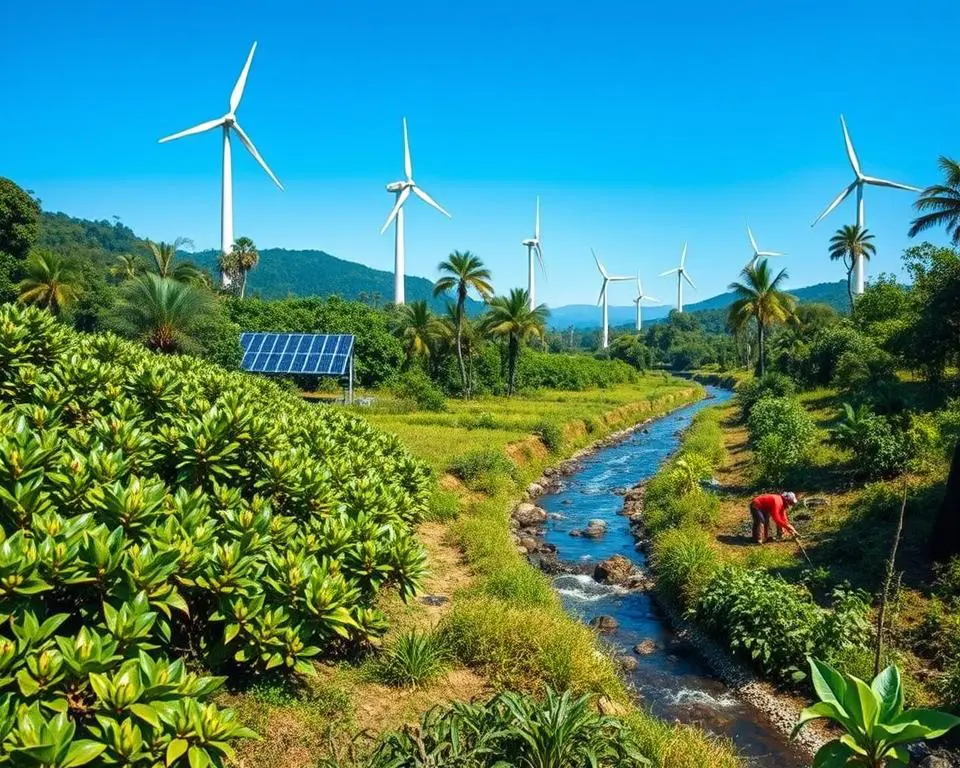
Responsible coffee cultivation protects soil, water, trees, and the farm's ability to produce coffee in the future. It protects the environment, supports fair wages, and ensures the long-term viability of coffee production.
Coffee plants grow under a canopy of native trees in shade cultivation. That system can protect habitat, reduce heat stress, slow soil erosion, and support a more varied farm. It also changes the coffee's growing conditions, so the result depends on the farm, variety, climate, and processing.
Key practices in sustainable coffee farming include:
- Shade-grown cultivation
- Organic farming
- Water conservation
- Agroforestry
- Integrated pest management
Integrated pest management means monitoring pests and using targeted controls instead of spraying everything on a fixed schedule. That takes more attention, but blanket chemical use can harm farm workers, soil life, water, and nearby habitats.
Coffee and tea production has become increasingly industrialized since the 1970s. Chemical-intensive fertilization and pest control can have negative social, economic, human, and environmental health impacts. The answer isn't to pretend every organic farm solves everything. The answer is to ask what the farm actually does.
Environmental claims need proof
“Eco-friendly” tells you almost nothing. Look for information about water use, wastewater, soil cover, shade trees, fertilizer, pest control, and habitat protection.
A farm can use shade and still struggle with worker pay. An organic farm can meet a chemical standard while offering weak labor protections. Sustainable coffee sourcing works best when environmental care sits beside fair purchasing and worker rights.
The shade-grown coffee guide explains the flavor trade-offs too. Shade can support slower ripening and more complex cups, but the word alone isn't a quality guarantee.
Farming labels need context
No single farming label proves ethical coffee farming. Shade-grown, organic, regenerative, and certified coffee each tell you something useful. None answers every question on its own.
Shade-grown coffee
Shade-grown coffee uses trees or other canopy plants above the coffee. It can protect biodiversity, reduce direct heat, and help the soil hold moisture.
Still, “shade-grown” has no universal meaning across every bag. Some companies provide details about canopy and farm management. Others use the phrase as decoration. Keep the claim if the company explains the system. Skip the vague version.
Organic coffee
Organic methods avoid harmful pesticides and fertilizers. They can reduce exposure risks and support healthier soil practices.
Organic certification focuses on defined production rules. It doesn't automatically prove fair pay, safe housing, or strong community investment. If labor conditions matter to you, check those separately.
Regenerative coffee
Regenerative farming usually focuses on rebuilding soil health, increasing plant diversity, reducing erosion, and improving the farm's resilience. The term sounds promising, but its standards vary widely.
Ask what changed on the farm. Does the company describe composting, cover crops, shade trees, water management, or reduced chemical use? If “regenerative” is the whole explanation, the explanation is missing.
Other responsible methods
Water conservation and agroforestry can strengthen a farm's long-term health. Integrated pest management can reduce unnecessary chemical use. These methods work best as part of a wider plan.
The right approach depends on local soil, weather, pests, labor, and farm size. A rigid rule that ignores those conditions is usually cargo-cult sustainability. Good coffee farming requires observation and adjustment.
Workers and communities need protection
Responsible coffee sourcing includes the people who grow, pick, process, transport, and prepare the coffee. A farmer payment claim means little if workers face unsafe conditions or children are pushed into hazardous labor.
Ethical supply chains should support good working conditions, prohibit child labor, and respect workers' rights throughout the supply chain. They should also:
- Support fair wages
- Protect workers from abuse and discrimination
- Improve access to education and healthcare
- Include women in farm decisions and leadership
- Strengthen local roads, water systems, and processing facilities
- Support farmer-owned cooperatives and organizations
The company should explain whether community programs were designed with local producers or dropped in from far away. A new classroom may photograph well. It may also fail if the community needed safe water, better drying equipment, or reliable transport instead.
Gender equity needs more than a women-focused label. Look for details about land access, training, payment control, leadership, and decision-making. Women often do major farm and processing work without receiving equal control over income.
Farmer-owned organizations can give producers more bargaining power and shared access to mills, training, credit, and market information. They aren't perfect by default, but they can shift decisions closer to the people doing the work.
Transparency shows how coffee moves

Transparency means a company can show how coffee moves from producer to roaster. Traceability means you can follow that coffee through the chain with enough detail to connect the claim to a real origin.
Ethical sourcing should create traceable supply chains so consumers can identify where coffee comes from and how it was produced. A country name is a start. A producer group, region, farm, harvest information, and processing method give you something stronger to work with.
Use this coffee sourcing guide when reading a product page or bag:
| Detail to look for | Why it matters |
|---|---|
| Country and growing region | Shows the stated origin |
| Farm, cooperative, or producer group | Identifies who produced the coffee |
| Processing method | Explains how the coffee was prepared after picking |
| Purchasing relationship | Shows who buys from whom |
| Payment or pricing information | Gives context for farmer income |
| Volume or harvest details | Helps test whether the claim is specific |
| Certification or audit | Shows how part of the claim is checked |
| Contact or reporting information | Gives the company some accountability |
What does direct trade actually prove?
Direct trade deserves extra caution. There is no official industry definition for direct trade. One roaster may use it for repeated farm visits. Another may use it for a purchase made through an exporter with limited producer contact.
Direct trade aims to let roasters pay producers more by cutting out middlemen. That can work, but the phrase does not prove that farmers received more. Direct trade green coffee sourcing requires significant planning, investment, and time to operate effectively and ethically.
Without middlemen, roasters are responsible for much of the trade and shipping process, including arranging transportation from origin to destination. A small roaster may have a sincere relationship and limited reporting. A large company may publish more data but still keep important purchasing details hidden.
Ask for the actual relationship and terms. The label matters less than the evidence.
Certifications verify limited claims
Certifications can verify defined standards. They cannot certify every part of a coffee's social, economic, and environmental story.
Fair trade programs may address farmer payment, worker protections, cooperative structures, and community benefits. Organic programs focus on production methods and restricted inputs. Rainforest Alliance certification covers environmental and social requirements within its standard.
Read the standard behind the logo. The Fairtrade International standards explain what that certification covers.
A certification can leave gaps:
- A certified coffee may represent only part of a company's total sourcing.
- A label may cover production rules without showing the final price paid.
- Audits happen within a defined scope and schedule.
- Certification costs and paperwork can exclude smaller producers.
- Environmental verification may not cover every labor concern.
- A direct relationship may provide useful detail without carrying a certification logo.
Independent audits are helpful when you can see the scope, standard, and corrective process. A company that admits a problem and explains how it fixed it often gives you more confidence than one claiming spotless perfection.
Certification is a check, not a moral hall pass.
A practical buying checklist
Start with the sourcing page, then compare it with the bag. The details should match. If the package names a farm but the website only mentions a country, the traceability is thin.
Use this checklist:
- The origin includes more than a broad country name.
- The company names a farm, cooperative, or producer group when possible.
- The sourcing page explains the buying relationship.
- Farmer payment is described with care, not vague claims.
- Worker safety and child labor policies are clear.
- Environmental practices include specific methods.
- Certifications link to a real standard or explain their scope.
- Community projects name the need they address.
- The company says how it handles problems.
- The coffee has a roast date and tastes fresh.
Be wary of phrases such as “good for farmers,” “planet-friendly,” and “direct from origin” without supporting detail. Those claims may be true. You have no useful way to judge them until the company explains who, where, how, and compared with what.
Freshness still matters. Ethical sourcing doesn't rescue stale coffee. Buy whole beans in an amount you'll use while they still taste lively, then grind before brewing. A balanced ratio and fresh-ground coffee will improve your morning more than a heroic paragraph about sustainability.
What should you ask before buying?
You can ask a brand these questions without turning your coffee purchase into a legal hearing:
- Which farm, cooperative, or producer group supplied this coffee?
- How long has the buying relationship lasted?
- How does the company set or negotiate the price?
- Does the payment cover production costs and support a living wage?
- Who handles exporting, importing, and shipping?
- What worker safety and child labor safeguards are in place?
- Which shade, soil, water, or pest practices does the farm use?
- What does the certification cover?
- Are the community projects chosen with local producers?
- How does the company check and report its claims?
You won't always get a complete answer. That response is information too. A company can say it protects farmer livelihoods while refusing to explain its purchasing terms. Keep looking.
Balancing quality, ethics, and everyday practicality
Choose the clearest credible information first, then buy the coffee you'll actually drink. Responsible choices don't require expensive gear, rare beans, or fussy rules.
A fresh bag from a transparent supply chain is a strong starting point. Use the brew ratio that gives you a balanced cup, then taste and adjust. If the coffee tastes thin and sour, use more coffee or a finer grind. If it tastes heavy and bitter, add water or back off a click.
Quality and ethics can support each other, but they aren't the same thing. A bright, silky cup doesn't prove fair pay. A certified coffee doesn't guarantee that you'll love its roast profile. Read the sourcing details, then judge the flavor in your own kitchen.
The best ethical coffee sourcing practices are the ones a company can explain plainly and support with records. Buy from producers and roasters that show their work, reward useful farming, and treat workers as part of the coffee rather than background scenery.
FAQ
Is ethical coffee always more expensive?
Not always. Retail price includes roasting, packaging, transport, labor, rent, and other costs, so it doesn't show the farmer's share by itself. Ask how the company sets producer payments instead of using the shelf price as your proof.
Can small coffee roasters source ethically without certification?
Yes. A small roaster may build a close producer relationship and provide detailed traceability without using a certification program. You should still ask how the claims are checked, because personal relationships don't replace clear evidence.
Does organic coffee mean the workers are treated fairly?
No. Organic rules focus on farming inputs and production practices. Worker wages, safety, rights, and community support need separate evidence.
Is a country of origin enough to prove traceability?
No. A country identifies a broad starting point, but it doesn't tell you which producers supplied the coffee or how the coffee moved through the chain. More specific origin and purchasing details make the claim easier to judge.
What should you do if a brand won't answer sourcing questions?
Choose a brand that provides better information. You don't need perfect reporting, but you should get a direct answer about origin, farmer relationships, and the checks behind the ethical sourcing claim.